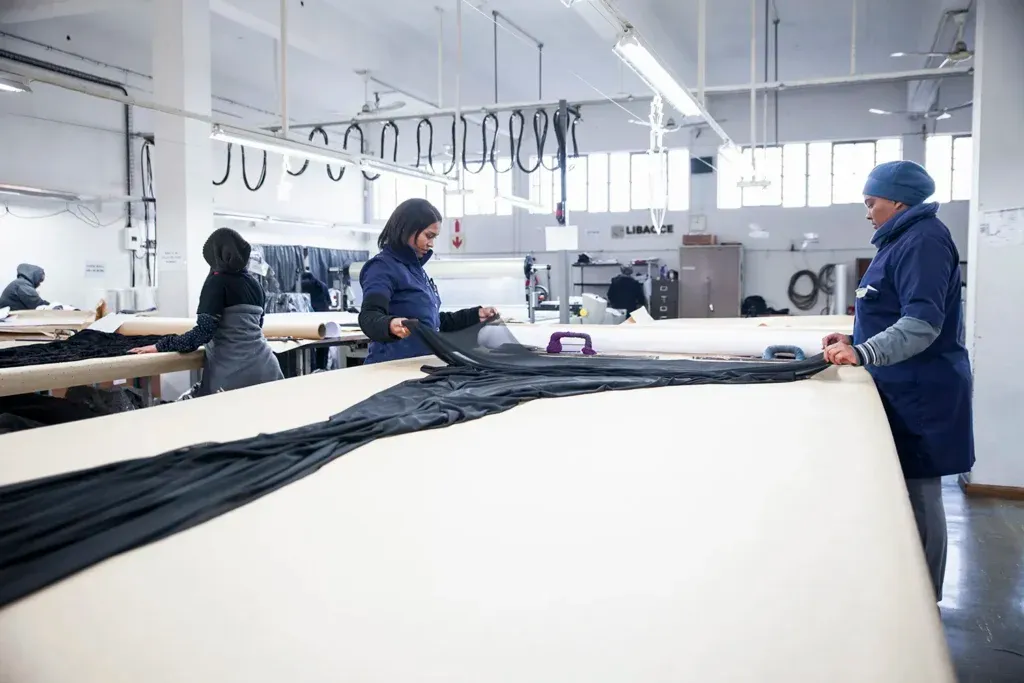
Sourcing medical textiles from Türkiye usually means a made-to-order programme: you send a specification, approve a sample, and production runs to your dimensions and your label. At Libacce, production typically completes within two to nine weeks depending on order size, there is no minimum order for products made from fabrics we hold in stock, and custom programmes are quoted individually. For buyers in the EU, the customs union between the EU and Türkiye is a further practical advantage.
Why source medical textiles from Türkiye?
- Proximity to Europe: shorter transit than from Asia, and easier visits and follow-up.
- A deep textile supply base: fabrics, coatings, zips and trims are available locally.
- The EU–Türkiye customs union: industrial products in free circulation, textiles included, can move between Türkiye and the EU without customs duties when accompanied by an A.TR movement certificate. Confirm the details for your product with your customs broker.
- Flexible runs: manufacturers who make small and medium runs to specification, not only large catalogue volumes.
What lead time should you expect?
At Libacce, production typically completes within two to nine weeks depending on order size, and the exact lead time is confirmed in writing in the quotation before production starts. Plan for the sample stage at the start of a new programme and for transit to your warehouse at the end.
Is there a minimum order quantity?
For products made from fabrics we hold in stock there is no minimum order quantity. Custom productions, such as a special fabric, colour or construction, are quoted per programme. Tell us what you need and we will confirm what is workable.
How does a private-label programme work?
- Specification: product, dimensions, materials, performance and target market.
- Quotation: price, lead time and delivery terms in writing.
- Sample run: the real construction, not a swatch, so you can test it.
- Approval: the approved sample becomes the reference for every production run.
- Production: with your labels and packaging.
- Inspection and packing: seams, closures and dimensions are checked, and goods are packed in the format your warehouse needs.
Our article on OEM and private-label textile manufacturing in Türkiye covers what to send a manufacturer at the start.
Which certificates and documents should you ask for?
- Management-system certificates. We hold ISO 13485:2016, ISO 9001:2015, ISO 14001:2015 and ISO 10002:2018, issued by BELCERT; their validity can be checked at belcert.com.
- Test reports for the construction you are buying, for example EN 20811 (waterproofness), ASTM E96 (breathability) and BS 7175 (flame retardancy).
- Material certificates such as OEKO-TEX® Standard 100. Our barrier fabric is Class 1.
- Shipping documents: commercial invoice, packing list, and the movement or origin certificate your import requires.
Who is responsible for regulatory compliance?
Where a product falls under a medical device framework, its classification depends on the product and the market it is placed on. The company that places the product on the market carries obligations; in the EU, for example, a company that sells a medical device under its own name generally takes on the manufacturer's obligations. Agree early which documentation your manufacturer will provide. We work with the buyer's regulatory requirements for the destination market rather than asserting a classification on their behalf. See our quality page.
How is delivery arranged?
Packaging is prepared for export, and delivery terms are agreed in the quotation, using the Incoterm that suits you. We currently ship to the Netherlands, Germany, Ukraine, Romania, Spain, Azerbaijan and Saudi Arabia.
What should your first email contain?
- The product and its dimensions
- First-order quantity and expected annual volume
- The market it will be sold in
- Labelling and packaging needs
- Your target delivery date
Send it through our quote form and our technical team will reply, usually within 24 hours on business days. Browse the product range first if you want to see what we make.