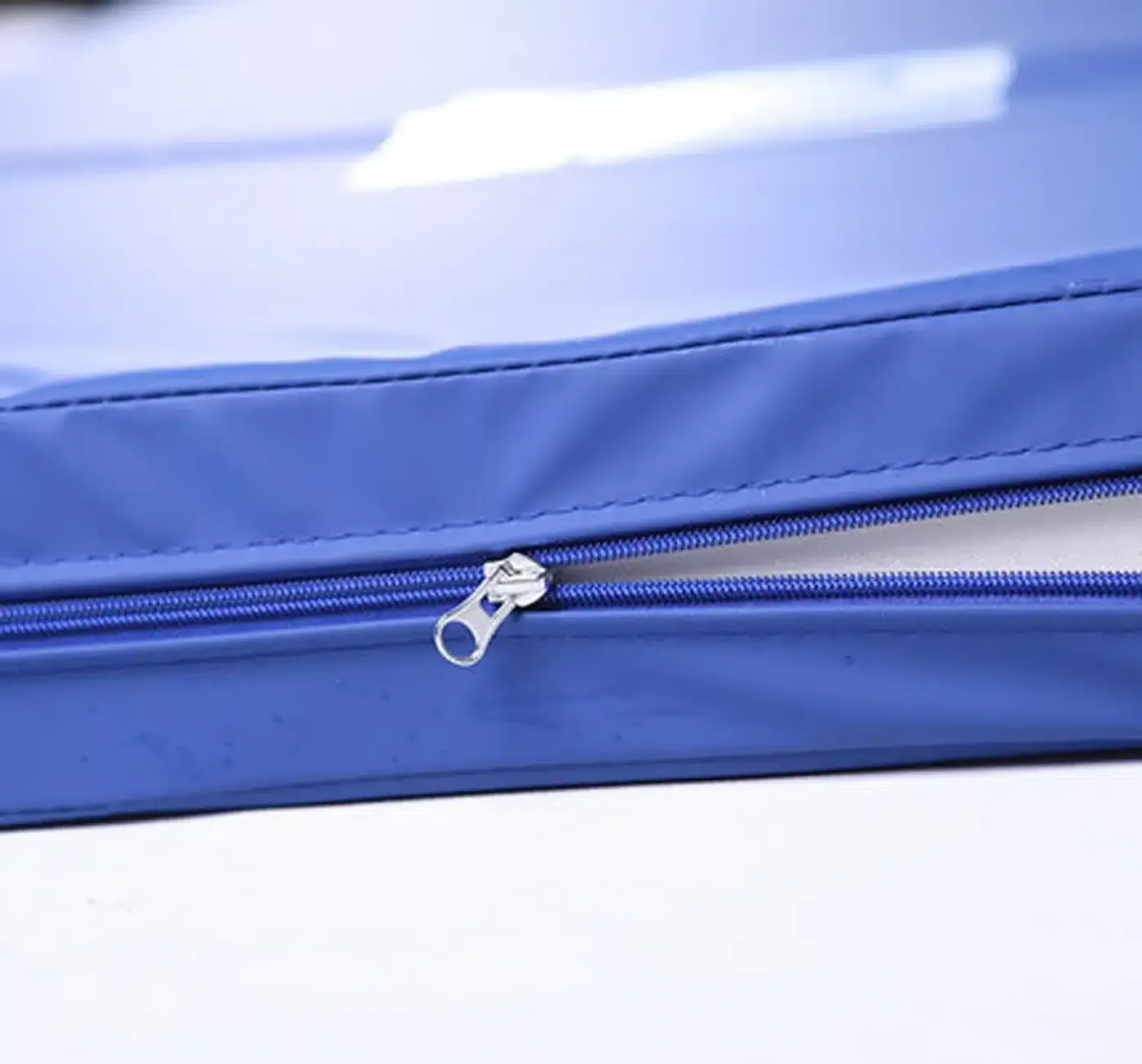
Replace a hospital mattress cover as soon as its barrier is compromised: a tear, puncture or split seam, a zip that no longer closes, a coating that is cracking, peeling or tacky, or any staining on the inside of the cover or on the foam. There is no fixed lifespan in months. How long a cover lasts depends on use, cleaning chemistry and laundering, and regular inspection is what tells you when the time has come.
Why replace a cover that still looks fine on top?
A cover can look clean on the surface while fluid has already passed through a pinhole, a seam or the zip. The foam underneath cannot be properly cleaned, so a failed cover can turn the mattress into a reservoir of contamination. That is why inspection has to include the inside.
What are the signs a cover needs replacing?
- Tears, cuts, punctures or holes, including small ones from needles or bed frames.
- Split or open seams, especially at the corners.
- A zip that sticks, separates or has missing teeth.
- A surface that is cracked, peeling, tacky or has gone stiff.
- Stains, tide marks or odour on the inside of the cover.
- Staining or wetness on the foam core.
- A cover that no longer fits: shrunk, stretched, or creasing on the mattress.
How should you inspect a mattress cover?
- Check the top surface and sides for damage and changes in texture.
- Unzip the cover fully.
- Inspect the inside of the cover and the whole foam core, underside included.
- Check the seams and the zip along their full length.
- Record the result, so you can see how covers age in your facility.
Inspect between patients and at a set interval agreed with your infection-control team. Our guide to cleaning a PU hospital mattress cover builds this check into the cleaning routine.
Should you replace the foam as well?
If the foam is stained or wet, fluid has reached the core. Replace the mattress or core as well as the cover, following your facility's protocol. Replacing only the cover would put a clean barrier over a contaminated core.
What shortens a cover's life?
- Cleaning chemicals used stronger than recommended, or left on when the instructions say to rinse.
- Wash temperatures above the cover's rating, and hot tumble drying.
- Sharp edges on bed frames and equipment.
- Dragging, or folding the cover in ways that stress the zip and seams.
- A cover of the wrong size, which strains the seams or creases.
How can you make covers last longer?
- Specify for your real laundry. Tell the supplier the wash temperature, the chemistry and how often each cover is washed.
- Get the size right. A made-to-measure cover with two-way stretch fits without strain.
- Use disinfectant at its recommended strength.
- Keep spares. A damaged cover can then be replaced the same day instead of staying in service.
How durable is the Libacce PU fabric?
The PU-coated barrier fabric in our covers can be washed at up to 85 °C, withstands 20 autoclave cycles at 121 °C with no loss of performance (internal test method), and showed no loss of quality after three weeks of accelerated ageing (jungle test, ISO 1419). Its peel adhesion, the bond between coating and knit, is at least 35 N/50 mm (ISO 2411). Full values are on our quality page.
Need replacements? Our PU hospital mattress cover is made to your mattress size. Request a quote.